In a busy warehouse, a doorway is more than an opening. It affects traffic flow, temperature control, and how safely people and equipment move between work areas. A forklift waiting for a slow door can interrupt a shift; repeated exposure to outside air may also challenge climate-sensitive operations. Small delays add up.
Why are high speed doors better than traditional rolling doors? In many facilities, they open and close faster, helping reduce waiting time and limit air exchange. Their flexible curtains can also be useful where minor impacts occur, while compact designs may preserve valuable floor and ceiling space. These benefits depend on the door’s specifications, installation, and maintenance—not just its advertised speed.
Traditional rolling doors still suit some buildings, especially where security, durability, or lower initial cost matters more than frequent passage. A high-speed model may not be the right choice for every opening. Site conditions, traffic volume, washdown needs, and available service support should all be considered. An overlooked detail, such as a poorly placed sensor, can affect daily performance.
This guide explores seven practical reasons businesses choose high-speed doors, from smoother traffic flow to better separation between work zones. It also considers the trade-offs, so readers can compare options with realistic expectations and make a decision suited to their facility.
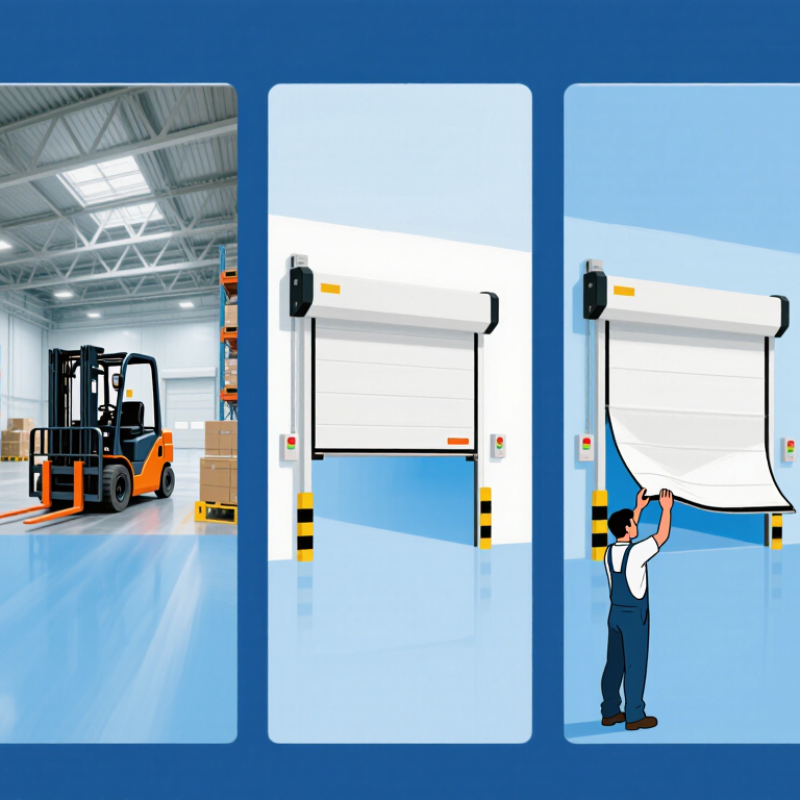
Rolling doors typically use interlocking metal slats that coil above an opening. High-speed doors often use a flexible curtain that travels along side guides. Their construction affects how they operate, what they withstand, and where they fit best. The details matter.
High-speed doors open and close quickly, making them useful where forklifts or staff pass through frequently. Seconds matter. Shorter opening times can help limit drafts, dust, and temperature exchange, though results depend on the building and traffic patterns. A fast curtain is not, by itself, an energy-efficiency solution. Seals, controls, and correct installation also count.
Rolling doors often provide a more rigid barrier and may suit openings with lower traffic or greater exposure to impact. High-speed curtains can sometimes recover from a minor collision, but designs vary, and damage is still possible. Maintenance differs, too: operators should inspect tracks, sensors, seals, and moving parts on either type. In a busy warehouse, the right choice depends on traffic frequency, opening size, climate control needs, and available service support. I would not choose by speed alone; that can overlook practical costs.
How Faster Opening Cycles Improve Traffic Flow
In a busy warehouse, every slow door can become a small traffic jam. A forklift waits with a pallet, another truck queues behind it, and workers adjust their routes. The Door & Access Systems Manufacturers Association’s Technical Data Sheet 267 uses an opening speed of about 24 inches per second (0.61 m/s) as a high-performance benchmark. For a three-metre opening, that speed means roughly five seconds to open. At 0.2 m/s, the same opening takes about 15 seconds. That comparison is illustrative, not a universal rolling-door specification; actual speeds depend on the door and operator.
Those seconds matter most at frequently used passages. Faster cycles can shorten queues, reduce stop-and-start forklift movement, and help keep people and pallet traffic moving through the same work area. DASMA guidance also highlights cycle frequency when selecting high-performance doors, so a busy opening needs equipment rated for its actual daily use—not just impressive top speed. Still, speed alone is not magic. Sensors, sightlines, maintenance, and sensible traffic separation affect whether a doorway flows smoothly. I’ve seen a fast door lose its advantage when a pallet is left in its path. For a fair comparison, measure opening time and queue delays during a representative shift, then check whether the door’s rated cycle capacity matches that workload.
| Reason | Operational Dimension | High Speed Doors | Conventional Rolling Doors | Traffic-Flow Benefit |
|---|---|---|---|---|
| 1. Faster opening | Typical opening speed | Often about 0.5–2.0 m/s, depending on door design and settings. | Often slower; conventional models may open at roughly 0.1–0.3 m/s. Actual speeds vary by model. | Vehicles and pedestrians can pass through sooner when the opening cycle is shorter. |
| 2. Shorter waiting time | Time spent waiting at the doorway | A rapid cycle can reduce the time a vehicle waits for the door to open and close. | A slower cycle can keep vehicles waiting longer, especially at busy access points. | Helps reduce delays at frequently used doorways; the actual effect depends on traffic volume and control settings. |
| 3. Smoother vehicle flow | Queue formation | Shorter door cycles can help vehicles maintain a steadier pace through a controlled opening. | Longer cycles may interrupt movement when arrivals are frequent. | Can help limit stop-and-go movement at docks, internal routes, and other high-traffic transitions. |
| 4. Less time left open | Open-door exposure | Fast opening and closing can reduce the duration of each opening when automatic controls are correctly configured. | Slower operation may leave an opening exposed for longer during each cycle. | Helps keep the route available while limiting unnecessary open time between passes. |
| 5. Better environmental separation | Air exchange between areas | Shorter open periods can help limit air exchange between spaces with different temperatures or conditions. | Longer open periods may allow more time for air to pass between areas. | Can support temperature management and reduce drafts; results depend on building conditions and door use. |
| 6. Suited to frequent cycles | Duty cycle and usage frequency | Many high-speed models are designed for frequent operation; confirm the cycle rating for the specific application. | Rolling doors vary in duty rating and may require a model selected for the expected usage frequency. | Choosing a door rated for the actual number of daily cycles helps maintain reliable access on busy routes. |
| 7. Potentially improved visibility | Line of sight through the opening | Some designs include vision panels or transparent sections, which can help users see approaching traffic. | Visibility depends on the curtain design; many conventional slat curtains provide limited visibility. | Where visibility features are included, they can help people coordinate crossings and avoid unnecessary stops. |
Note: Speed ranges are typical examples, not universal specifications. Door speed, cycle time, safety equipment, and performance vary by model, size, controls, installation, and site conditions. Follow the manufacturer’s specifications and applicable safety requirements.
How Reduced Air Exchange Helps Maintain Indoor Conditions
Every open doorway lets conditioned air escape and outdoor air enter. In busy facilities, a conventional rolling door may stay open long enough for warm, humid air or dust to drift inside. A high speed door opens and closes quickly, shortening that exchange. The difference can matter near temperature-sensitive work areas, refrigerated zones, or spaces where airborne particles are a concern. It is practical, not magic.
Tips: Track how long each doorway stays open during a typical shift. Check the floor for drafts, condensation, or dust near the opening. Keep sensors and door edges clean so the door can close reliably.
Reduced air exchange can ease the workload on heating, cooling, and ventilation systems. Staff may notice fewer warm gusts in summer or less cold air pooling by the entrance in winter. Yet results depend on more than door speed. Poor seals, constant traffic, and incorrect controls can undermine the benefit. A fast door also needs suitable maintenance and safe, well-planned access. Real facilities are messy; one busy loading period can change the picture.
In a busy loading bay, a forklift may meet a pedestrian at a doorway within seconds. High-speed doors can reopen quickly between trips, while clear vision panels help workers see movement on the other side. That extra sightline matters when pallets, stacked cartons, or vehicle frames block the view. A warning light or sensor can add another cue, but only when installed for the actual traffic pattern.
OSHA cites estimates of about 85 deaths and 34,900 serious injuries each year involving powered industrial trucks. These figures cover forklift incidents broadly; they do not prove that a particular door prevents injuries. Still, they show why visibility and controlled traffic deserve attention. A door that opens quickly may reduce waiting and help limit the time a passage remains open. It cannot replace marked walkways, trained operators, or safe speeds.
Details matter. Keep vision panels clean, check sensors routinely, and make sure the door’s opening cycle suits the vehicles using it. Dust, glare, or a parked load can still hide someone from view. A transparent panel is not a magic fix. In some facilities, the faster cycle may also encourage people to rush through. That is worth monitoring, not assuming away. The best choice depends on door placement, traffic volume, and maintenance—not speed alone.
Qualitative comparison of typical operational suitability (1 = lower, 5 = higher). Ratings are directional, not measured industry data; actual performance depends on the door model, installation, and site conditions.
High-speed doors are often chosen where frequent cycles, quick access, and visibility are priorities. Rolling doors may suit openings where a robust barrier is the main requirement. Both types can be equipped with safety devices, so compare the specific models and site requirements.
Maintenance costs depend less on the door’s label than on its daily workload. A high-speed door may cycle hundreds of times during a busy shift. Its motor, guides, curtain, and safety sensors need regular inspection. Small sensor misalignment can stop operation or trigger repeated resets. That matters.
Rolling doors often move more slowly and may have simpler operating systems. Yet their slats, tracks, and springs still wear, especially where forklifts pass close to the opening. A damaged slat can lead to repairs and downtime. Comparing service costs means checking parts availability, inspection intervals, and repair response times—not just the purchase price.
Operating costs can favor high-speed doors in climate-controlled spaces. They close quickly, reducing the time warm or cooled air escapes through a busy doorway. The savings vary with traffic, building layout, and temperature differences. In a low-traffic area, the energy benefit may be modest. A rolling door may then be the less costly fit. One practical estimate can be wrong, so track opening cycles, energy use, and repair hours before deciding.
High-speed doors usually use flexible curtains and side guides. Rolling doors use interlocking metal slats that coil overhead.
They suit busy openings used often by forklifts or staff. Faster closing may limit drafts and temperature exchange. Seconds matter.
No. Savings depend on traffic, building layout, temperature differences, seals, controls, and installation. A fast curtain alone is not enough.
Rolling doors often create a more rigid barrier. Some high-speed curtains can recover from minor collisions, but damage remains possible. Designs vary.
Check tracks, sensors, seals, and moving parts. High-speed doors also need attention to guides, curtains, and motors. Small misalignment can interrupt operation.
Not automatically. Slats, tracks, and springs wear, especially near forklift traffic. Repair costs also depend on parts availability and service response.
Compare purchase price, inspection intervals, parts, repairs, and downtime. Track opening cycles, energy use, and repair hours. Estimates can miss things.
Consider traffic frequency, opening size, climate-control needs, and service support. Speed alone is a shaky basis; actual use may change the answer.
High-speed doors and traditional rolling doors may serve similar purposes, but their operating speed can make a meaningful difference in busy facilities. Faster opening and closing cycles help vehicles, staff, and equipment move through access points with fewer delays. By staying open for less time, high-speed doors can also reduce the exchange of air between indoor and outdoor areas, helping facilities maintain more consistent temperatures and environmental conditions.
Why are high speed doors better than traditional rolling doors? In many daily operations, the advantages include improved traffic flow, reduced air loss, and safety features such as sensors and visibility panels that help people notice approaching activity. Their suitability depends on the facility, usage, and operating conditions, but comparing maintenance needs and energy-related operating costs can help determine long-term value. Together, speed, visibility, and efficiency make high-speed doors a practical option for locations with frequent door cycles.

Vistaro Door